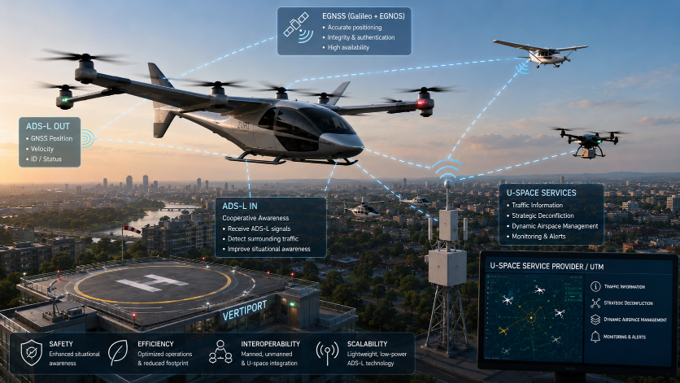
Cooperative awareness in the airspace refers to the capability of airspace users to electronically share positioning, velocity and operational information in real time in order to improve situational awareness, traffic coordination and operational safety. This concept is becoming a key enabler for the integration of Innovative Air Mobility (IAM), Vertical Take-Off and Landing Capable Aircraft (VCA) and unmanned aircraft systems (UAS) within increasingly dense and complex low-altitude airspace environments.
In the context of U-space, cooperative awareness is essential to enable the safe coexistence of manned and unmanned aircraft operating simultaneously within shared airspace volumes. U-space services rely on accurate and continuous exchange of surveillance and positioning data to support traffic information services, strategic deconfliction, dynamic airspace management and future highly automated operations.
The VITOLMINS project addresses cooperative awareness through the development and integration of advanced e-conspicuity technologies supported by EGNSS services, including Galileo and EGNOS. The project focuses specifically on the implementation and demonstration of ADS-L (Automatic Dependent Surveillance – Light), a lightweight cooperative surveillance technology designed to support scalable and cost-efficient U-space operations.
ADS-L is an emerging e-conspicuity standard derived from GNSS-based cooperative surveillance principles and specifically optimized for lightweight aviation applications. The “Light” concept behind ADS-L aims to reduce system complexity, power consumption and integration costs while maintaining the essential functionality required for cooperative traffic awareness and electronic visibility within shared airspace.
Unlike conventional surveillance systems requiring complex avionics architectures and certified transponder equipment, ADS-L has been conceived to support integration into compact and affordable airborne devices, making it particularly suitable for drones, lightweight aircraft and next-generation VTOL platforms. This approach is especially relevant for future U-space ecosystems, where a very large number of airspace users will require interoperable and reliable electronic conspicuity capabilities without excessive hardware or certification burdens.
The ADS-L concept implemented within VITOLMINS is based on GNSS-derived positioning data and operates over the licence-free SRD-860 frequency band, in compliance with the EASA Technical Specification for ADS-L transmissions using SRD-860. The use of this dedicated low-power band enables efficient broadcasting of aircraft position and identification information while supporting lightweight and low-cost implementations.
Within the project, the ADS-L functionality will be integrated into an intelligent U-space beacon designed specifically for VCA operations. The beacon will continuously broadcast the aircraft position and operational information to surrounding airspace users and U-space service providers, enabling the aircraft to be electronically visible during flight operations inside U-space airspace.