ZURI

Advanced regional air mobility with hybrid VTOL

Prague, Czechia

Zuri is a Prague-based aerospace company developing a hybrid-electric tiltrotor VTOL aircraft for regional air mobility, in both piloted and unmanned variants. Zuri is a partner in the VITOLMINS Horizon Europe consortium, contributing the Technology Demonstrator 2.0 as the platform for the project's flight validation of next-generation navigation, communication, and airspace integration technologies. The aircraft is built to serve four mission categories that together address regional connectivity, civil resilience, and public safety. The following subsections describe those missions, the architectural choices that follow from them, and the demonstrator currently in build.

Mission set

The full-scale Zuri aircraft is being developed to address four mission categories within a single airframe, configured through interior variants rather than separate aircraft types.

Many regions are under-served by commercial aviation, which concentrates connectivity around major hub airports, and by ground transport, which is constrained by speed and infrastructure. A VTOL aircraft with regional range and the ability to access point-to-point landing sites can connect smaller communities, business centres, and remote destinations on routes where neither commercial flight nor surface transport is well suited.

Time-critical and high-value goods movement, including middle-mile distribution between regional hubs, benefits from an aircraft that combines runway independence with fixed-wing range and payload. Operators in express logistics, medical supply distribution, and humanitarian aid delivery are among the addressable users.

The combination of vertical access, regional range, lower acoustic signature, and lower operating cost than a conventional medium helicopter is operationally meaningful for medical evacuation, mountain rescue, and rapid response missions. The aircraft can reach incident sites that fixed-wing aircraft cannot serve and operate over distances that limit current helicopter response.

Intelligence, surveillance, and reconnaissance missions, border patrol, and forward resupply are addressable through a mission-system variant of the same airframe. The strategic context within Europe, including renewed attention to civil resilience and defence capability, makes this a category in which European-developed dual-use aviation technology is of growing importance.

Architectural approach

The aircraft is a hybrid-electric tiltrotor VTOL:

- Tiltrotor configuration was selected for mass efficiency. A single propulsion system used in two orientations replaces the dual systems carried by lift-and-cruise designs, reducing empty weight and improving the payload and range fractions that the regional mission set requires.

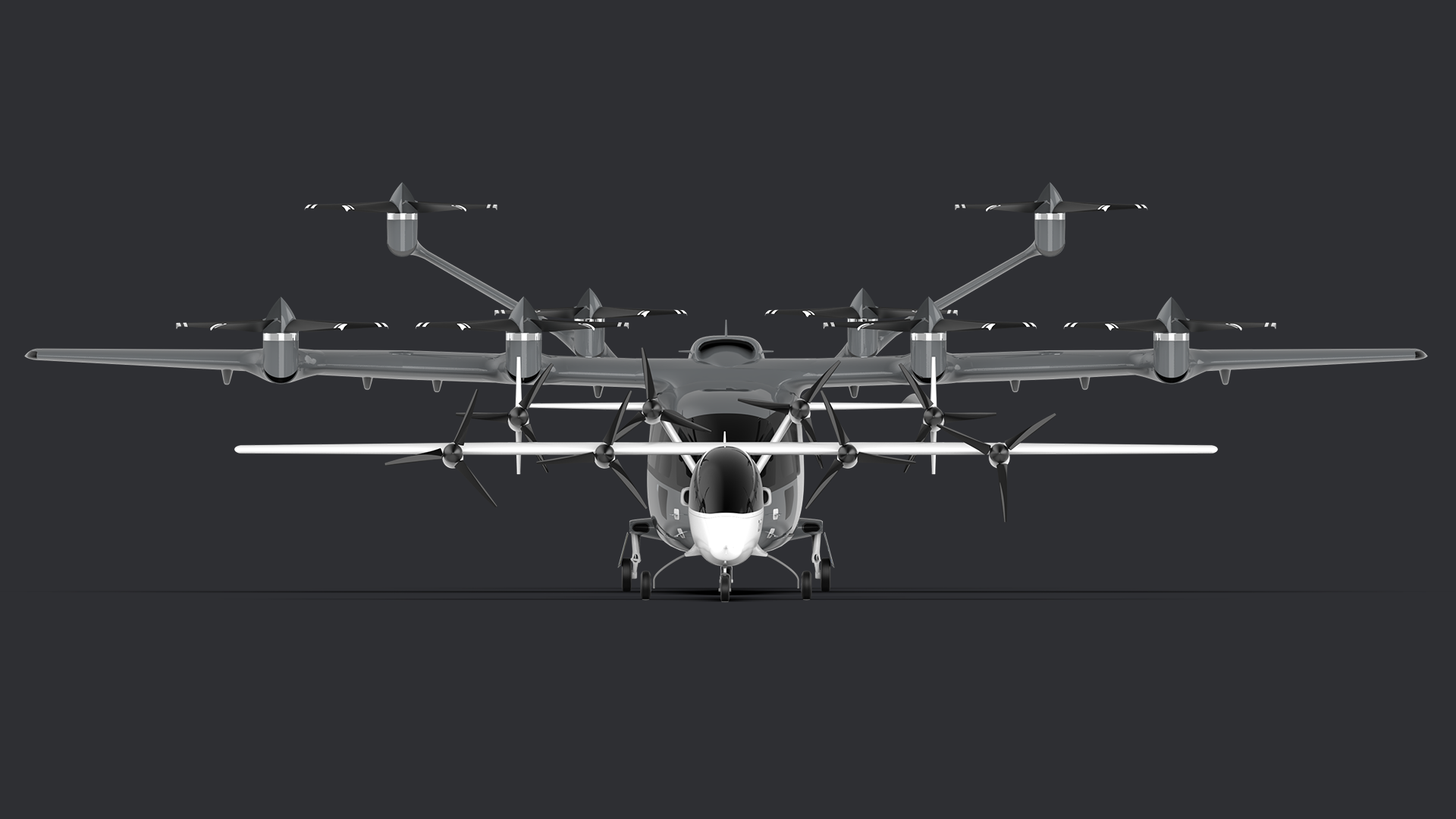
- Eight tiltrotors were selected for control authority, redundancy, and acoustic signature. Distributing thrust across eight independent propulsion units allows fine-grained differential thrust control in hover, maintains controlled flight after the loss of up to two motors in VTOL configuration, and permits smaller individual rotor diameters operating at lower tip speeds. The acoustic benefit matters operationally: lower-noise aircraft can serve more landing sites, more often, with less community impact.

- Series-hybrid propulsion was selected to deliver useful regional range using available technology rather than depending on future improvements in battery energy density or charging infrastructure. The combustion engine drives a generator that powers the electric propulsion units throughout the flight. The battery is sized for the peak power demand of take-off and landing and is recharged in flight from the generator during cruise. This sizing keeps battery mass substantially smaller than in an all-electric design of comparable range, and removes operational dependence on ground charging infrastructure. The aircraft uses certified aviation fuels including Jet-A and sustainable aviation fuel, compatible with existing airport and heliport fuel supply networks worldwide.

- Conventional take-off and landing capability was retained alongside vertical operations for operational flexibility. The same aircraft can operate from purpose-built vertiports and from conventional airfields, widening the addressable mission set and reducing dependence on any single class of infrastructure.
Zuri Technology Demonstrator 2.0
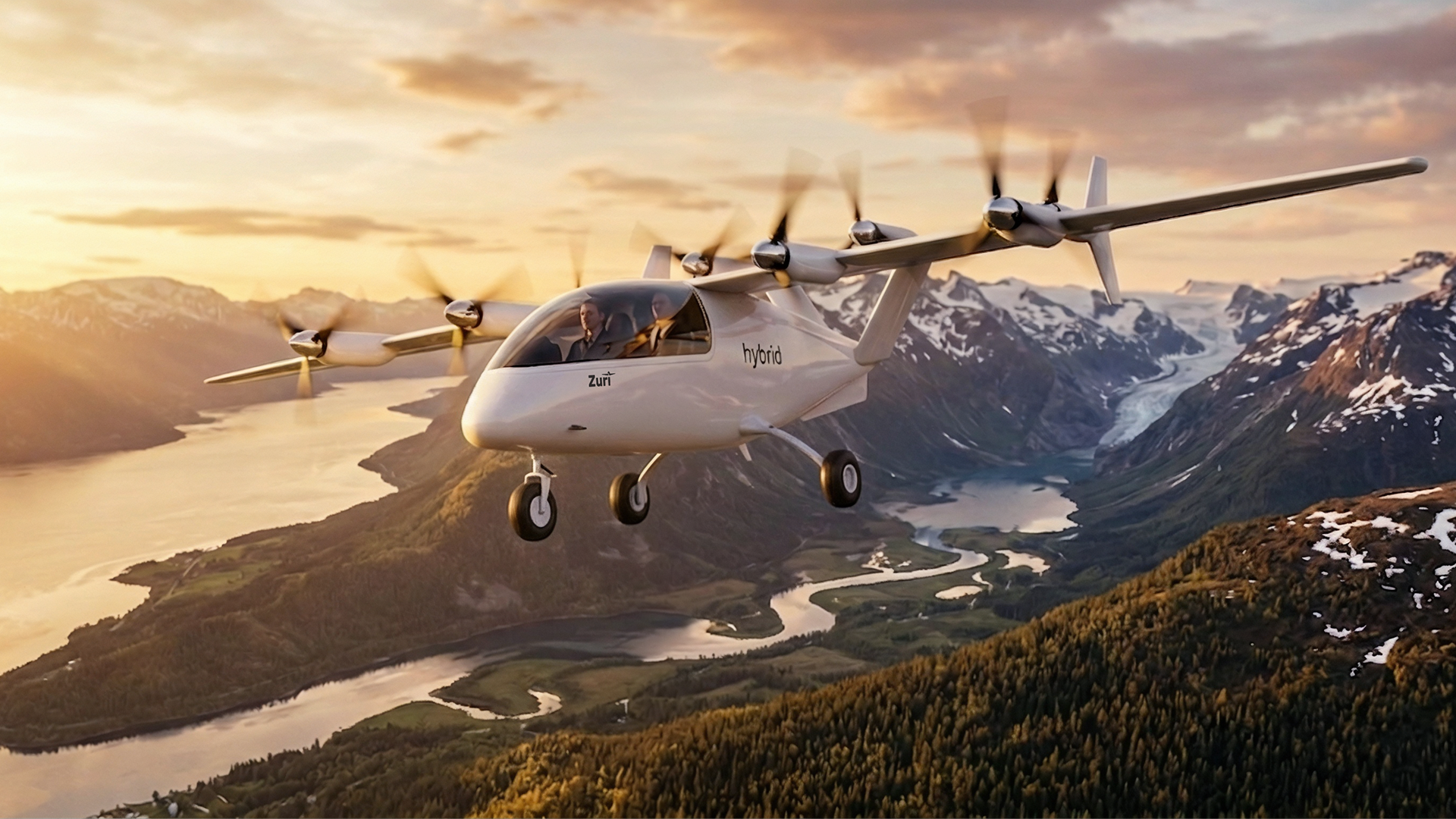
The Zuri Technology Demonstrator 2.0 (TD 2.0) is a hybrid-electric tiltrotor aircraft in a two-seat configuration, currently in build at Zuri's Prague workshop and unveiled at AERO Friedrichshafen in April 2026. The airframe has a maximum take-off weight of approximately 695 kg, a wingspan of 9.7 m, a cruise speed of approximately 240 km/h, and an endurance of approximately two hours. First flight is planned for the period from late 2026 to early 2027. Although the airframe is dimensioned to accommodate two seats, TD 2.0 will fly as a remotely piloted aircraft throughout its flight test programme.

TD 2.0 carries the same architectural configuration as the full-scale aircraft: eight tilting rotors with variable pitch, series-hybrid propulsion with a piston-electric generator and four independent battery packs, and fly-by-wire flight control with redundant flight control units. Flight test is planned in the Czech Republic under EASA SORA (Specific Operations Risk Assessment) conditions.

Within the VITOLMINS project, TD 2.0 serves as the platform for flight validation of next-generation navigation, communication, and airspace integration technologies. Zuri is developing both remotely piloted and optionally piloted variants in parallel; configuration details specific to the VITOLMINS demonstration are addressed in the Projects section of this portal.

Beyond its primary role validating technology for the full-scale aircraft, Zuri is also evaluating the possibility of bringing remotely piloted and optionally piloted aircraft based on the TD 2.0 work to market in their own right. These options remain open as the demonstrator progresses through flight test.

This website or its third party tools make use of cookies to enhance browsing experience and provide additional functionality. If you want to know more or withdraw your consent to all or some of the cookies, please refer to the cookies policy. Accept Reject