Instrument Flight Procedure

Instrument Flight Procedures (IFP) are precisely designed navigation routes that guide aircraft safely and efficiently when operating under Instrument Flight Rules (IFR), especially in low-visibility conditions. In these situations, pilots cannot rely on visual references and must navigate using only the aircraft’s instruments and external navigation aids.

One of the key concepts in the design of these procedures is MOC, or Minimum Obstacle Clearance, which establishes a minimum altitude margin between the aircraft and any obstacle. This margin varies depending on the phase of flight, the type of procedure, and the airspace, ensuring at all times that the aircraft remains at a safe distance from terrain and other obstacles. Another essential element is the use of protection areas, which are zones surrounding the intended route and designed to account for possible deviations caused by navigation errors. These areas ensure that the aircraft maintains safe separation from obstacles and other aircraft, becoming narrower as the aircraft progresses toward the final approach phase, where greater precision is required.

The design of these procedures follows criteria established by ICAO, the International Civil Aviation Organization, ensuring that they meet the accuracy, integrity, and continuity requirements necessary for modern air navigation. In addition, Performance-Based Navigation (PBN) makes it possible to design more direct and efficient routes through the use of satellite technology. In this context, RNP, or Required Navigation Performance, defines the level of accuracy required for each phase of flight. This standard ensures that an aircraft, when properly equipped and certified, can operate within a specific airspace while meeting very strict error margins. To achieve this, the performance of the navigation system is assessed and verified against established limits, thereby ensuring safe and reliable operations.
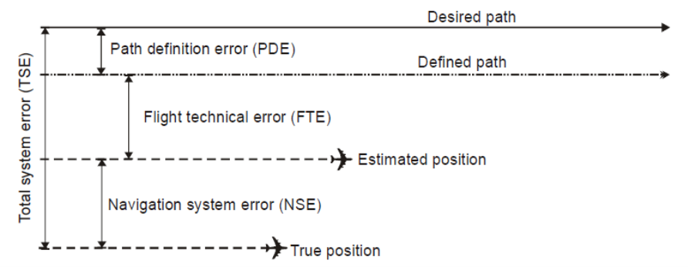
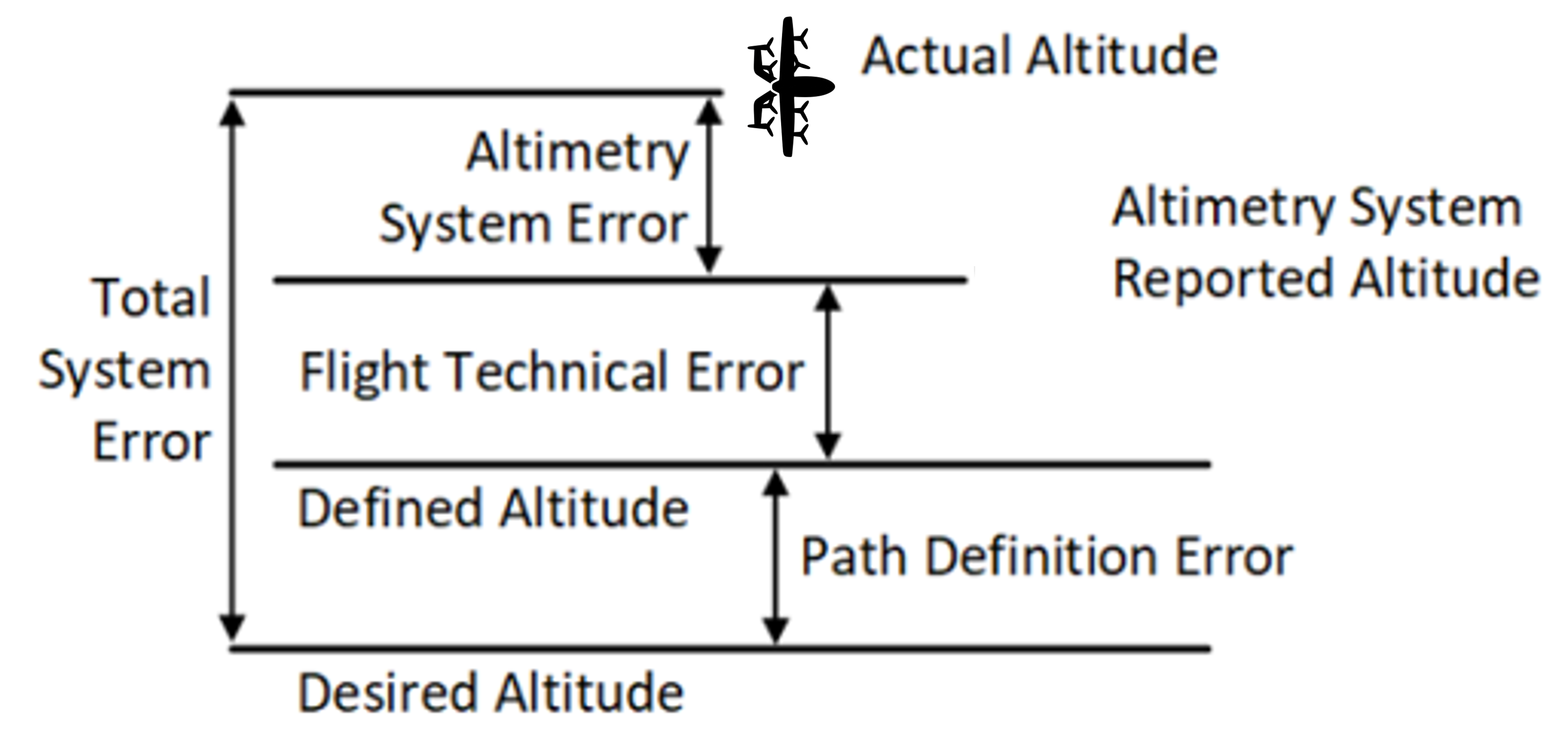
In the horizontal domain, the Total System Error (TSE) measures the navigation accuracy of an aircraft and is continuously assessed during flight through a probability distribution. This distribution must meet two requirements:

  • The TSE must remain within the required navigation accuracy value (RNP) at least 95% of the time.
  • The probability that the TSE exceeds the established limit — equal to twice the accuracy value — must be less than 10⁻⁵.

In turn, the Total System Error depends on:

  • Navigation System Error (NSE): This represents the difference between the position estimated by the navigation system and the actual position of the aircraft.
  • Flight Technical Error (FTE): This reflects how well the crew, or the autopilot, follows the desired flight path.
  • Path Definition Error (PDE): This occurs when the desired flight path is not correctly defined in the navigation system.

Regarding the error in the vertical domain, it can be obtained in an analogous way by applying the same contributing factors as in the horizontal case.

Vertical deviations from the nominal path are protected by minimum obstacle clearance margins, known as MOC, which vary depending on the phase of flight. The most common values used in procedure design are:

  • 1,000 ft (300 m) during the en-route phase, arrivals, and initial approach segments.
  • 500 ft (150 m) in the intermediate approach segment.
  • 250 ft (75 m) in the final approach segment for non-precision approaches, and in departures, where this value represents the maximum permitted clearance.

Types of Instrument Flight Procedures

These are predefined procedures designed to guide aircraft from the runway to the cruise phase, ensuring a safe and efficient climb. These procedures establish specific altitudes and headings in order to maintain separation from other traffic and ensure minimum obstacle clearance during the initial phase of flight.

Their use is especially common at airports with high traffic volumes, as they allow departure routes after take-off to be standardized. This helps reduce the workload for both pilots and air traffic controllers by simplifying and organizing departure manoeuvres within the terminal airspace.

These are procedures designed to facilitate the transition from the cruise phase to the approach phase. These standardized arrival routes manage the flow of incoming traffic in an orderly manner and allow a smooth transition to approach procedures, while ensuring separation from other traffic and avoiding conflicts or proximity to obstacles.

STARs incorporate specific navigation points, known as waypoints, assigned altitudes, and speed restrictions, helping to maintain proper spacing and sequencing of approaching aircraft. These routes guide aircraft from the last point of the en-route phase to the desired initial approach fix, thereby optimizing efficiency and safety during the terminal phase of flight.

These procedures guide the aircraft from the initial approach fix to the runway, ensuring safe landings even in low-visibility conditions. They can be classified into three main types:

  • Precision Approaches (PA). These provide high-precision lateral and vertical guidance down to a decision height, allowing controlled and accurate descents toward the runway. A typical example is the ILS, or Instrument Landing System, which meets the most demanding precision standards.
  • Approaches with Vertical Guidance (APV). These also provide lateral and vertical guidance, but do not meet the technical criteria required to be considered precision approaches. Even so, they allow a more controlled descent than non-precision approaches. Common examples include LPV and LNAV/VNAV.
  • Non-Precision Approaches (NPA). These provide only lateral guidance, without vertical guidance, and terminate at a minimum descent altitude. They require greater attention and manual handling by the pilot during descent. Examples include LOC and VOR/DME approaches.
This website or its third party tools make use of cookies to enhance browsing experience and provide additional functionality. If you want to know more or withdraw your consent to all or some of the cookies, please refer to the cookies policy. Accept Reject