VTOL aircraft operate across two fundamentally different aerodynamic regimes within a single flight. In hover and low-speed flight, lift is generated by accelerating air downward through rotors. In cruise, lift is generated by airflow over fixed lifting surfaces. The transition between these regimes is unique to VTOL aircraft and shapes much of the engineering work behind any practical design.
Hover vs forward flight trade-offs
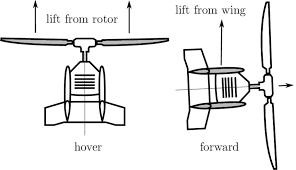
Hover is energetically expensive. To remain stationary in the air, an aircraft must continuously accelerate a column of air downward at a rate sufficient to support its weight. The power required scales with the cube of the induced velocity in the rotor wake. Large rotors moving a large volume of air slowly are aerodynamically efficient in hover; small rotors moving a small volume of air quickly are not.
Forward flight is energetically cheaper because a wing generates lift by deflecting a much larger column of air through a much smaller angle. The same aircraft weight that requires several hundred kilowatts to hover may require only a fraction of that power to maintain in cruise once wing-borne lift is established. This ratio between hover and cruise power demand is one of the most important parameters in VTOL design, and it is the principal reason most regional-class VTOL aircraft incorporate a fixed wing.
The two regimes pull in opposite directions for almost every design choice. A rotor optimised for efficient hover is not well suited to providing efficient forward thrust in cruise. A wing sized for efficient cruise contributes little to hover performance and adds parasitic mass during vertical operations. The choice of configuration is, in large part, a choice about how to manage these competing requirements.
Transition phase challenges
The transition between hover and forward flight is the most demanding phase of operation for any VTOL aircraft that uses different mechanisms to support its weight in the two regimes. During transition, the aircraft is moving fast enough that aerodynamic forces on the airframe are significant, but not yet fast enough for wing-borne lift to fully support the aircraft. Rotor thrust and wing lift must be coordinated continuously, often through a window of only a few tens of seconds.
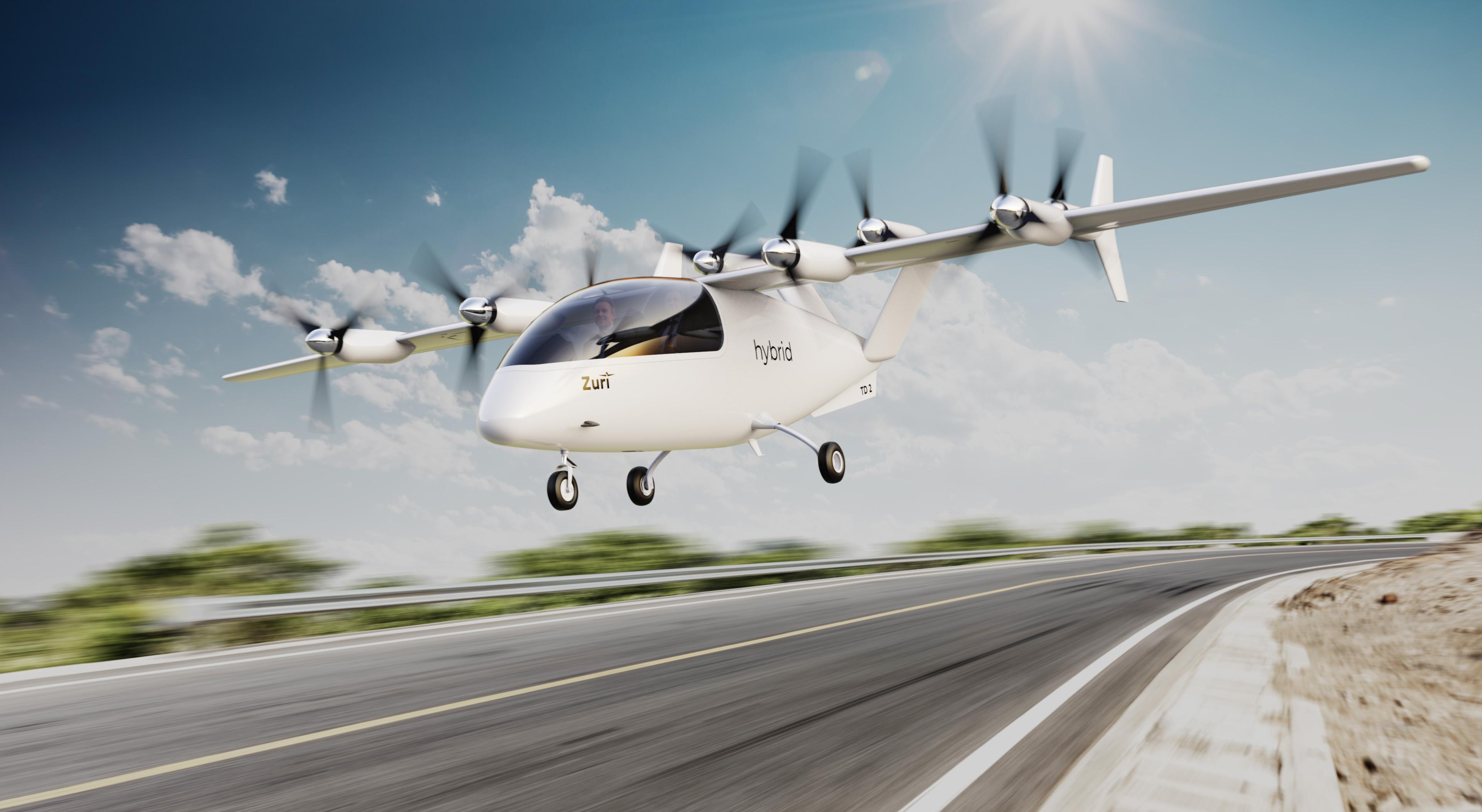
The control problem is non-linear. In a tilting-propulsion design, the rotors rotate through intermediate angles where they provide both vertical and horizontal force components. In a lift-and-cruise design, the lift rotors must be progressively unloaded and shut down or folded as the wing takes over, while the cruise propulsion accelerates the aircraft through the speed range where wing lift becomes sufficient.
Stability and control authority must be maintained throughout. Many of the certification challenges for new VTOL aircraft concentrate on the transition envelope, where the failure modes are most complex and the recovery margins narrowest. Modern flight control systems address transition through pre-programmed schedules, gain scheduling tied to airspeed, and in some designs continuous optimisation of individual rotor states.
Disk loading, wing loading, and acoustic signature
These design parameters explain much of the performance and noise difference between VTOL configurations:
Disk loading is the aircraft's weight divided by the total swept area of its lift rotors, expressed in kilograms per square metre. Low disk loading means the aircraft moves a large volume of air at a low velocity, which is aerodynamically efficient in hover and acoustically quiet. High disk loading means a smaller volume of air accelerated to a higher velocity, which is less efficient in hover and considerably louder. Conventional helicopters operate at disk loadings broadly in the range of 30 to 50 kg/m² [2].
Distributed-rotor architectures (tilting-propulsion and lift-and-cruise designs with many small rotors) can match or improve on this by summing the area of many smaller rotors. The total rotor disk area is what matters, not the size of any individual rotor.
Wing loading is the aircraft's weight divided by its wing area, and it governs cruise efficiency once the aircraft is in forward flight. For a VTOL aircraft that does not depend on a runway, wing loading can be optimised entirely for cruise performance, free of the runway-distance constraints that bound conventional fixed-wing design.
Acoustic signature in VTOL aircraft is dominated by rotor noise, which is governed primarily by rotor tip speed and disk loading. Helicopter noise carries the characteristic impulsive signature of blade-vortex interaction, produced when a rotor blade passes through the tip vortex shed by the preceding blade. Designs with many smaller rotors operating at lower tip speeds can reduce this impulsive component substantially, and variable-pitch and individually controlled rotor systems can further reduce noise by avoiding the operating conditions that produce blade-vortex interactions.
[1] Wagter, Christophe & Ruijsink, Rick & Smeur, Ewoud & Hecke, Kevin & Tienen, Freek & Horst, Erik & Remes, Bart. (2017). Design, Control and Visual Navigation of the DelftaCopter.
[2] Helicopter disk loading values per J. Gordon Leishman, Principles of Helicopter Aerodynamics, 2nd edition (Cambridge University Press, 2006), the industry-standard rotorcraft aerodynamics text.