VTOL aircraft fall into three principal architectural families: multicopters, lift-and-cruise designs, and vectored-thrust configurations. The distinction is not stylistic. It reflects how the aircraft uses its propulsion across the flight envelope, and that choice cascades through almost every other design decision: range, speed, payload, noise, mechanical complexity, and certification pathway.
The multicopter is the closest scaled-up relative of the small unmanned rotorcraft now common in commercial and consumer use. A set of distributed lift rotors, typically four or more, provides all thrust throughout the flight. There is no fixed wing. To move forward, the aircraft tilts its airframe attitude and redirects rotor thrust rearward, in the manner of a small multirotor drone.
The simplicity is the configuration's main strength. With no transition between flight regimes and no tilting mechanism, multicopters reach flight test and certification faster than the alternatives. The high count of independent rotors also provides inherent redundancy.
The trade-off is range. Without a wing to carry the aircraft in cruise, every kilometer of forward flight is powered by rotor thrust alone. Multicopter VTOL designs typically achieve ranges in the tens of kilometers and cruise speeds well below 150 km/h, which positions them for short urban missions rather than regional transport. The Vertical Flight Society World eVTOL Aircraft Directory, which catalogues more than 1,100 contemporary VTOL designs, shows the multicopter category clustered tightly in this performance band.
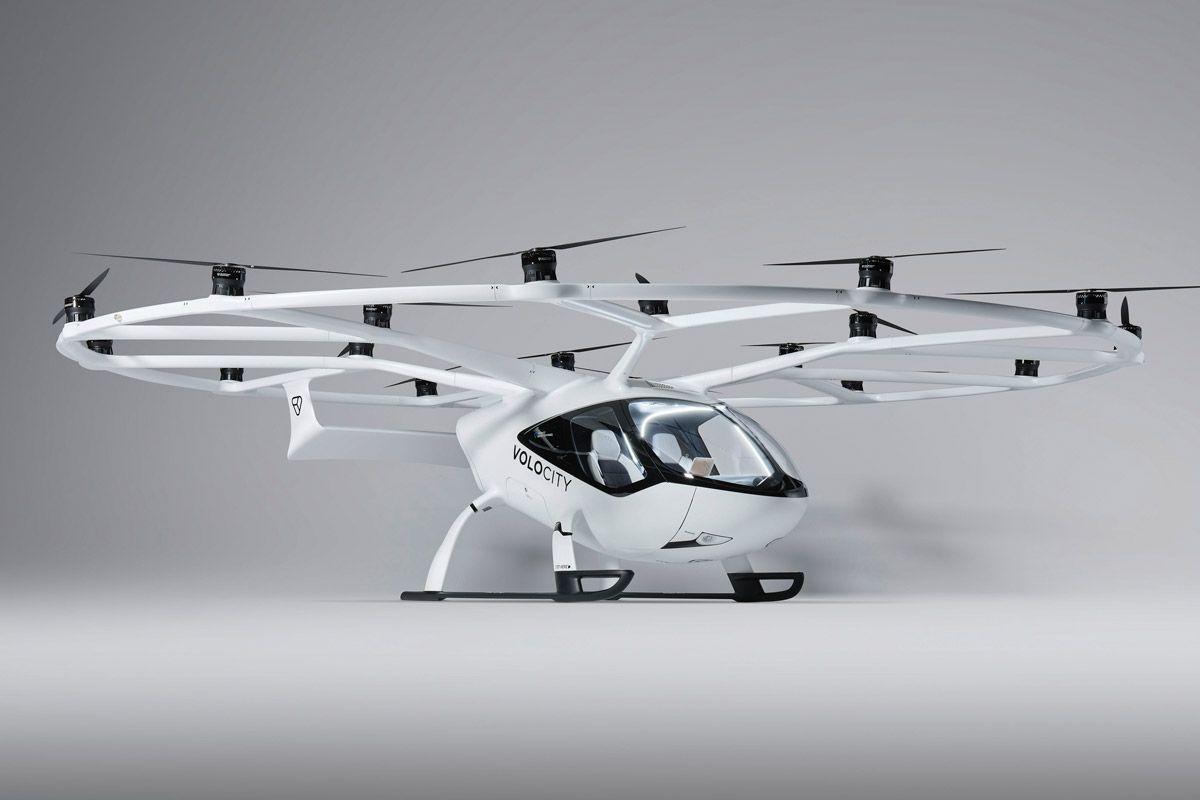
VoloCity, Volocopter
Lift-and-cruise designs combine a conventional fixed wing with two separate propulsion systems. One set of rotors lifts the aircraft vertically. A separate propulsion system, usually wing-mounted or tail-mounted as a pusher, drives the aircraft forward in cruise. Once airborne and at sufficient forward speed, the wing generates lift and the lift rotors stop, fold, or feather.
The architecture recovers the cruise efficiency of a fixed-wing aircraft. The wing carries the aircraft's weight in horizontal flight, and the cruise propulsion system is free to be optimised for forward thrust rather than hover.
The price is paid in mass. The aircraft carries two propulsion systems, of which one is unused at any given moment. The lift rotors contribute drag in cruise even when stopped or folded; the cruise propellers contribute mass through the entire mission. Transition is mechanically simpler than in a vectored-thrust design, but the control problem of unloading the lift rotors as the wing assumes the lifting role has its own subtleties.
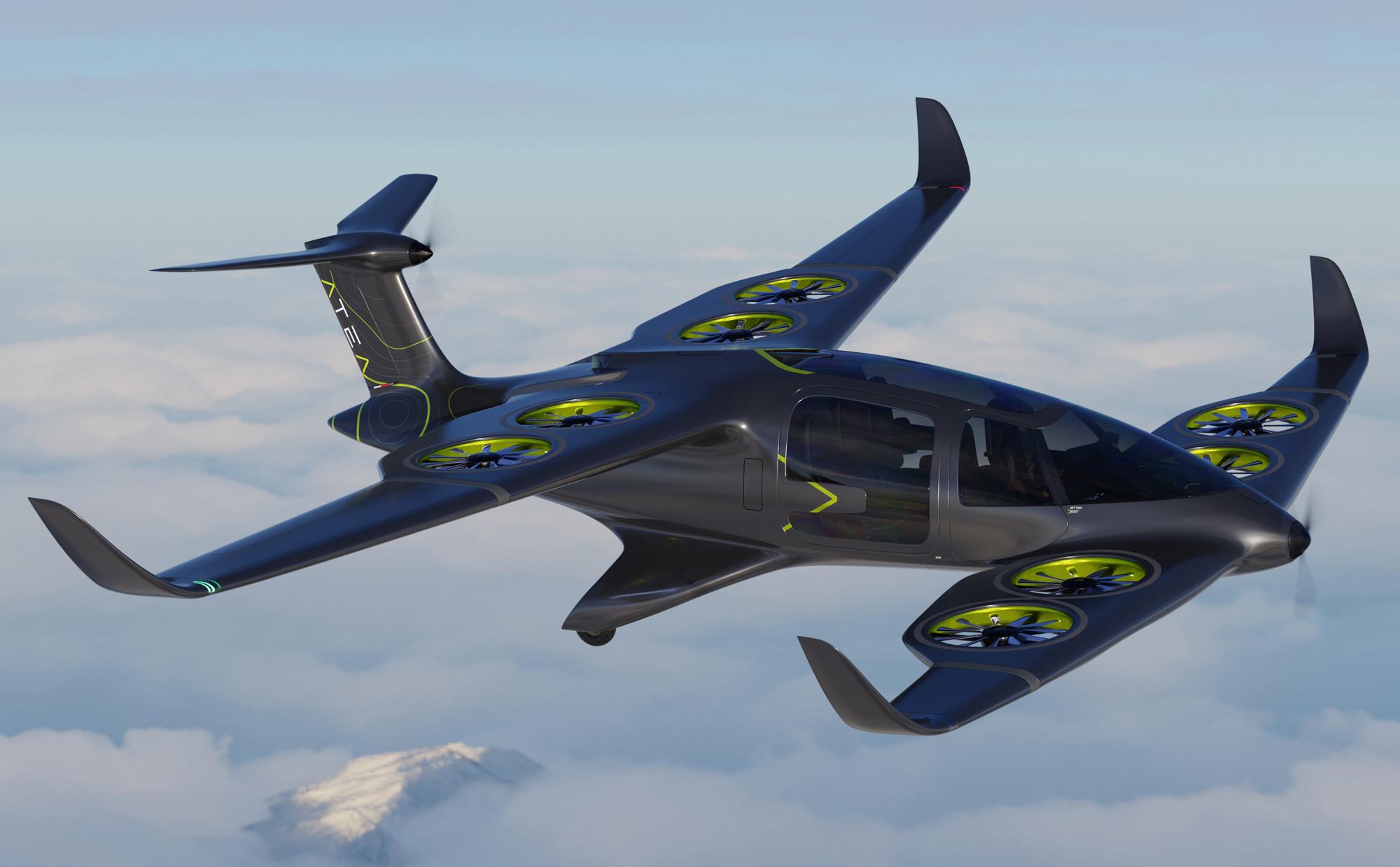
Atea, Ascendance
Vectored-thrust aircraft use a single set of propulsion units for both vertical lift and forward thrust. The same rotors that lift the aircraft from the pad rotate, together with their nacelles or the wing carrying them, into a forward-facing orientation as the aircraft accelerates. In cruise the wing carries the weight, the rotors provide horizontal thrust, and the aerodynamic configuration in forward flight is essentially that of a conventional fixed-wing aircraft.
The appeal is mass efficiency. One propulsion system, used in two orientations, replaces the dual systems carried by lift-and-cruise designs. The aircraft inherits both the hover capability of a rotorcraft and the cruise efficiency of an airplane.
The cost is engineering complexity. The tilting or vectoring mechanism is a critical-path system that must remain reliable across the full envelope. The transition phase is more demanding than in either of the other configurations, and the flight control laws must remain stable through a continuous change in flight regime rather than a clean handoff between two of them.
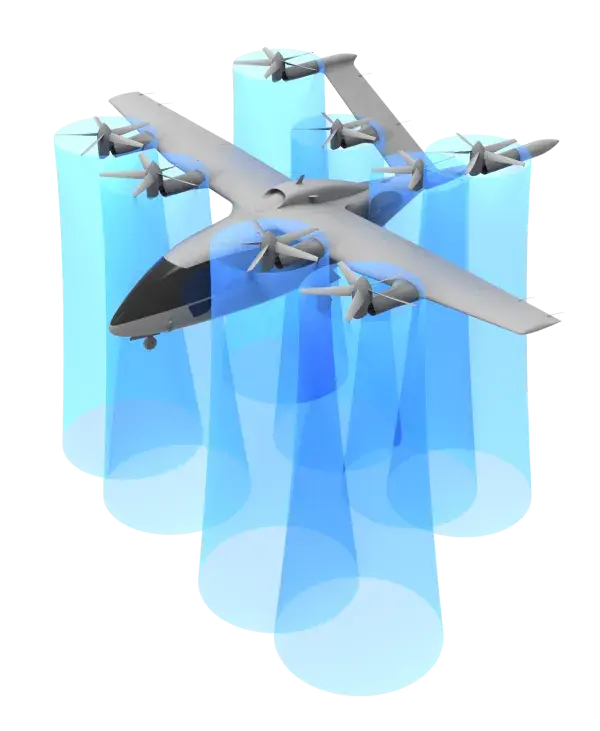
TD2.0, Zuri
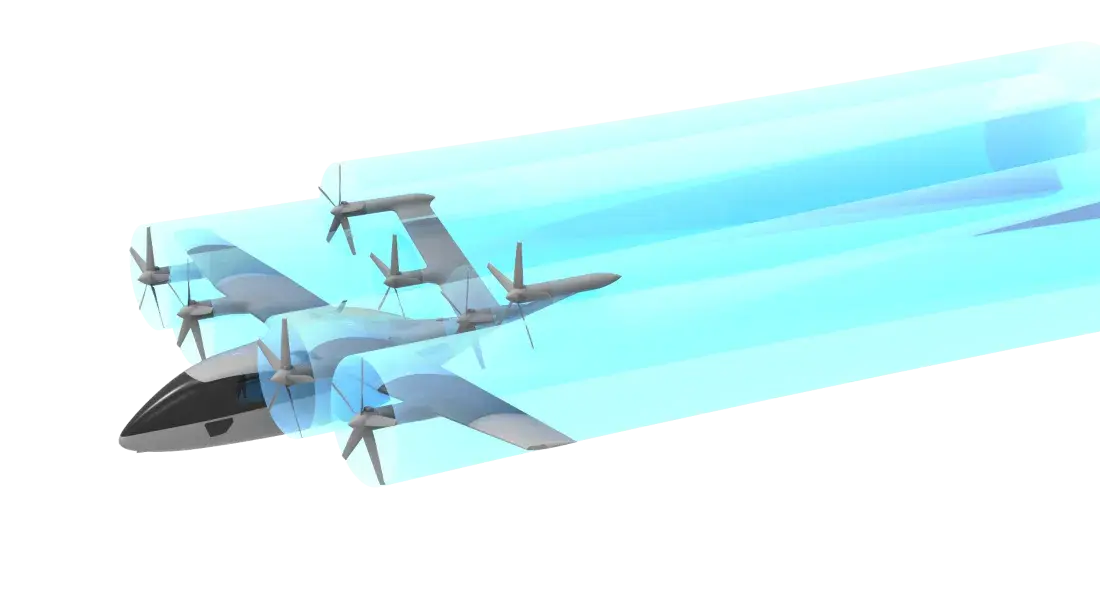
Three sub-architectures are commonly distinguished:
Tiltrotor designs rotate the propulsion units while the wing remains fixed, allowing the wing's aerodynamic surfaces to be optimised for cruise without compromise. The rotors themselves, often called proprotors in this context, must operate efficiently both as a hover rotor and as a cruise propeller, and reconciling these two regimes is the central design tension of the configuration.
Tiltwing designs rotate the entire wing together with its mounted propulsion units, which places the propulsion in the wing's slipstream throughout the flight at the cost of increased structural complexity where the wing meets the fuselage.
Ducted and ejector configurations redirect thrust through articulated nozzles, deflectors, or rotating ducted fans, which can reduce rotor tip noise and improve safety around personnel at the cost of duct weight and additional internal aerodynamic losses.